
- The gaming industry is one of the most rapidly growing and innovative tech industry sectors today, and it’s no secret that it’s a lucrative business. Its importance to culture, social networking and entertainment cannot be understated.
- The objective of this post is to give an overview of the video game industry trends in 2023. A particular focus will be on recent advances in gaming technology that would give gamers an even more immersive experience than ever.
Table of Contents
- Top Video Game Industry Trends
- Video Game Market Research
- Fashion and Video Games
- Advances in Gaming Technology
- AWS for Games
- ML/AI and Video Games
- Python Game Development
- Best Video Game APIs for Developers
- Available Open-Source Datasets
- Conclusions
- Explore More
Top Video Game Industry Trends
- The video gaming’s market maturity has led to a massive push for consolidation. The industry appears to be heading towards becoming even more top-heavy.
- InvestGame’s report points out that the gaming industry is starting to attract investment from non-traditional sources. In particular, the report highlights the recent investment by a number of large private equity firms in the gaming space.
- The industry is also expected to benefit from the release of new gaming consoles and the expansion of virtual and augmented reality technologies.
- The advent of Web3 gaming is another interesting factor that is on the horizon. Undoubtedly, the technology for Web3 gaming is still in embryonic form. However, if the gaming community adopts these new technologies, video gaming could receive another massive boost.
- Innovation will continue apace in virtual reality and augmented reality games.
- Multiplayer games will remain in strong demand.
- Non-player-character (NPC) chatbots will become more prominent.
2023 promises to be not “just another year” in gaming; it instead serves up the prospect of upending what we even consider games to be, look, and feel like.
Video Game Market Research
- The global video game market size was valued at USD 195.65 billion in 2021 and is expected to expand at a compound annual growth rate (CAGR) of 12.9% from 2022 to 2030.
- The gaming industry is projected to generate a revenue of $365.6 billion in 2023. Most revenue will come from China at 105.9 billion in 2023.
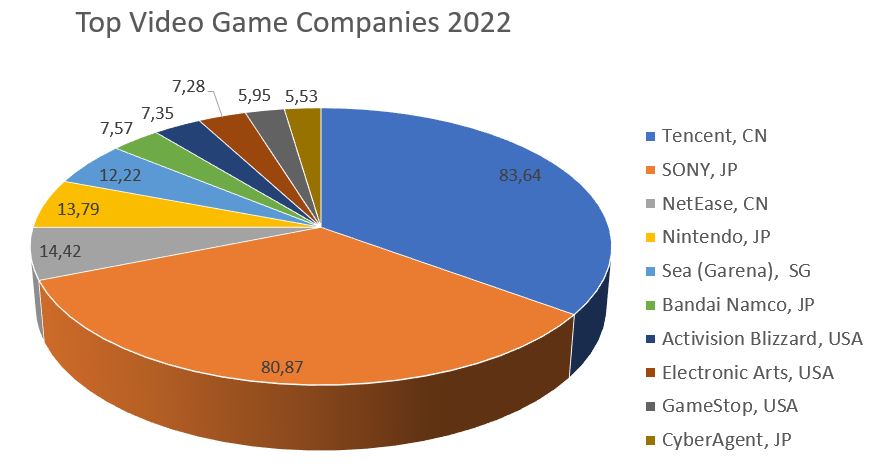
- As of now, Tencent is the largest video game company globally when it comes to revenue. The Chinese tech giant generated $83.64 billion in revenue last year. After Tencent, Japan-based SONY is the largest gaming company worldwide by revenue. SONY generated $80.87 billion of revenue last year. NetEase, Nintendo, and Sea ranked 3rd, 4th, and 5th with $14.42 B, $13.79 B, and 12.22 B of revenue in 2022.
- The top video game companies by revenue ($ Bn) are as follows:
Source – Companiesmarketcap.com
- The gender ratio of gamers in the US is fairly equal with 48% women and 52% men approximately.
- The gaming industry generates more revenue than filmed entertainment and music industry combined.
- The global gaming industry growth is projected from $229.16 billion in 2021 to $545.98 billion in 2028 at a CAGR of 13.20%.
- Consumer spending on video game subscriptions is expected to reach $8.5 bn in 2023. Furthermore, Video game subscription revenue is projected to reach $11 billion by 2025.
- Gen Alpha and Gen Z are the generation with the largest percentage of console and mobile players, followed by Millennials. Meanwhile, Millennials, who spend $112 a month on gaming, prefer PC gaming. Source – Financesonline.com
- Advances in technology and continued innovation in both hardware and software to enhance the real-time rendering of graphics are expected to drive the growth of the market over the forecast period.
- Newzoo reports there were 2.69 billion gamers in the world by the end of 2020. Growth has been steady with an average of 5.6% year-on-year (YoY) increase.
- The number of worldwide gamers is forecasted to reach 3.07 billion by the end of 2023 at a CAGR of 5.7%.
Bottom Line:
“Gaming is the most dynamic and exciting category in entertainment across all platforms today,” Satya Nadella, CEO of Microsoft.
Fashion and Video Games
In fact, the fashion industry is taking video games seriously due to their growing popularity and the potential for virtual sales, collaborations, and influencer marketing:
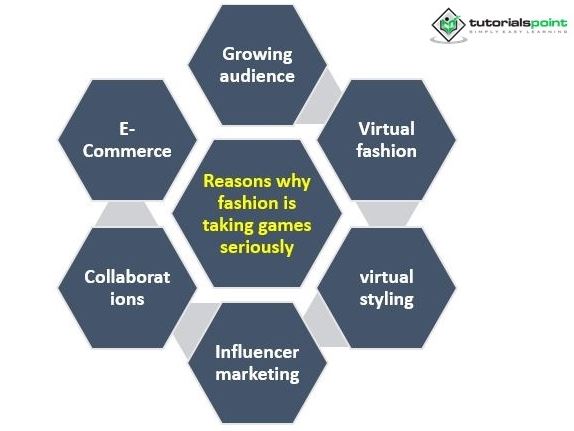
- Growing Audience − Video games have become increasingly popular over the years and now have a massive audience.
- Virtual Fashion − Video games have created a new market for virtual fashion, with players using virtual clothing and accessories to customise their avatars.
- Virtual Style − Video games allow players to create and customise their virtual avatars, giving them a platform to express their personal style.
- Influencer Marketing − With the rise of video game influencers and content creators, the gaming world has become a new platform for fashion brands to reach new audiences and promote their products.
- Collaborations − The gaming world and the fashion industry are collaborating in new ways, with fashion brands creating special in-game clothing items and accessories that are inspired by real-world fashion.
- E-commerce − The rise of e-commerce has made it easier for fashion brands to sell virtual clothing and accessories to players, creating a new revenue stream for the fashion industry.
Advances in Gaming Technology
- Rising Popularity of Mobile Gaming
- Augment Reality (AR)
- Virtual Reality (VR)
- Cloud-Based Gaming
- Using AI in Game Design
- Next-Gen Gaming Consoles
- X-Platform Gaming
- Emerging Business Models in Games
AWS for Games
Create next generation game experiences with AWS:
AWS for Games aligns purpose-built game development capabilities – including AWS services, AWS solutions, and AWS Partners – against six solution areas to help developers build, run, and grow their games: Cloud Game Development, Game Servers, Live Operations, Game Analytics, Game Security, and AI & Machine Learning.
Solutions on AWS:
- Persistent World Game Hosting on AWS
- Game Tech Cohort Modeler on AWS
- Achievements with Amazon GameSparks.
AWS Marketplace:
Game developer solutions from AWS Partners are also available on AWS Marketplace, a digital catalog of third-party software, services, and data that makes it easy to find, buy, deploy, and manage software on AWS.
ML/AI and Video Games
With the incorporation of ML/AI in the game development process, the following changes can and have been observed in the gaming experience:
- Reactive Non-Playable Characters – Thanks to ML, these characters can adapt according to the environment and the player’s game style.
- Modeling Complex Systems – To make a more immersive and practical world, developers are using the inherent strength of ML algorithms to make predictive models to predict the downstream of a player’s action.
- More Beautiful Games – The general problem with video-game graphics is that while they look good from a distance, they render poorly when viewed from proximity. Microsoft is working with Nvidia so that images can render dynamically and finer details can be seen when seen from close.
- Realistic Interactions – Typical open-world games require the player to interact with their environments and “fellow men” to complete the objectives. With the rise of Natural Language Processing, the player can interact with other characters in a more realistic manner.
- Dynamic Universe Creation – Most of the popular games in the industry are ‘open-world’ games that allow the player to interact with the environment. But this universe-creation takes a lot of time to be perfect and consists of repetitive and small tasks. With the help of ML, the time taken by the process has been reduced manifold and the developers can utilize the time saved in more creative processes.
- Engaging Mobile Games – Mobile Games contribute about 50% of the revenue generated by video games. The scope of these games is limited because of the hardware of smartphones. But this situation has started to change as now AI chips are getting installed into the latest smartphones.
Python Game Development
- The use of Python for game development is increasing because it is turning out to be an apt choice for game development. With the help of cutting-edge tools and techniques, a Python development company can develop apps and games with high-end features.
- Apart from developing games, companies can also use Python for automation, NLP ML/AI, digital marketing, etc. It is one of the most preferred programming languages for data processing, analytics, and visualization as well.
- A renowned Python development company offers end-to-end gaming development services to make a high-end game using Python. Python developers use many game libraries for creating new games for the users.
- Developers mostly use PyGame, Turtle, or many other Python gaming libraries to develop a GUI to operate the entire gaming program.
- Python allows you to implement AI in your game development and game optimization.
- Developers can make visualizations, real-time 3D games, and much more using the 3D libraries.
Best Video Game APIs for Developers
Gaming APIs tap into game servers and allow users to create accounts and subscriptions, access statistics, and analyze gameplay action.
Let’s look at the following 10 APIs to be the very best:
- Call of Duty: Modern Warfare API
- RAWG Video Games Database API
- Chicken Coop API
- Pokemon Go API
- PokeAPI
- IGDB API
- SteamWeb API
- Dota2 API
- League of Legends API
- Minecraft API
Available Open-Source Datasets
There are 9 gaming datasets available on data.world:
- PEW-Gaming-Broadband
- Fortnite Statistics_80 Game
- 2019/W35: PCs to Become the Smallest Gaming Platform in 2018
- Pokemon Wonder Trade Results
- Smogon 6v6 Pokemon Tiers
- Starcraft 2 “Skillcraft 1”
- NUMBER ELEVEN
- Gambling permits
- Steam Video Game Hours Played
Examples of Kaggle video games datasets:
- Video Game Dataset – 474417 video games on over 50 platforms including mobiles.
- Video Game Sales – a list of video games with sales greater than 100,000 copies. It was generated by a scrape of vgchartz.com.
- Video Game Sales and Ratings – a list of video games with sales greater than 100,000 copies along with critic and user ratings.
Conclusions
These are the trends that are shaping the gaming industry in 2023:
- Mobile games development
- Cloud gaming
- AR VR gaming
- Mobile gaming
- X-platform gaming
- Esports
- The Metaverse
- Blockchain and P2E gaming
- Indie games are on the rise
Explore More
- Customer Reviews NLP Spacy Analysis and ML/AI Demand Forecasting of the Steam PC Video Game Service
- Video Game Sales Data Visualization, Wrangling and Market Analysis in Python


Make a one-time donation
Make a monthly donation
Make a yearly donation
Choose an amount
Or enter a custom amount
Your contribution is appreciated.
Your contribution is appreciated.
Your contribution is appreciated.
DonateDonate monthlyDonate yearly Our Blogs
Leave a comment