

- The Internet of Things (IoT) is a sprawling set of technologies and use cases that has no clear, single definition. One workable view frames IoT as the use of network-connected devices, embedded in the physical environment, to improve some existing process or to enable a new scenario not previously possible.
- IoT is being called a major driver of the Fourth Industrial Revolution (IR). Professor Klaus Schwab describes the Fourth IR as “the fusion of technologies that is blurring the lines between the physical, digital, and biological spheres.”
- The uses of IoT: predictive maintenance, industry safety solutions, building and home automation, remote patient monitoring, asset tracking, and fraud detection.
- The last few years cloud IoT architectures have made great strides in their ability to ingest, store, process, and analyze very large amounts of real-time data.
Table of Contents
- Step 1: IoT Devices
- Step 2: Cloud IoT Edge
- Step 3: Ingest, Process & Analyze IoT Data
- Step 4: Data Analytics & MLOps Deployment
- Step 5: Big Data Insights & Decision Support
- Google BigQuery
- The Dataprep Pipeline
- The Data Studio Pipeline
- GCP vs Azure IoT
- Summary
- Explore More
- References
Step 1: IoT Devices
- IoT devices are connected to the cloud directly or through a gateway, as shown below

Step 2: Cloud IoT Edge
- GCP Release Edge TPU and Cloud IoT Edge
- Google Cloud IoT Edge: The Powerful Data Processing and Machine Learning Platform for Edge Devices.


Step 3: Ingest, Process & Analyze IoT Data
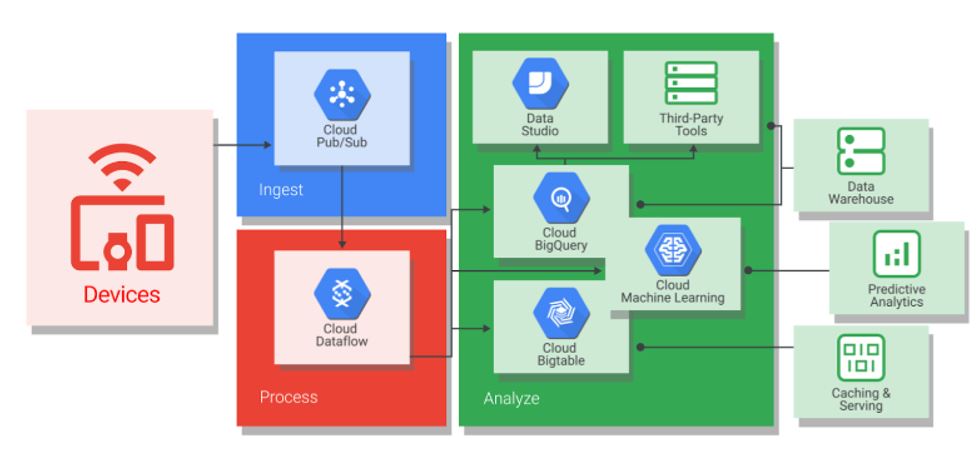
Step 4: Data Analytics & MLOps Deployment
- MLOps: Continuous delivery and automation pipelines in machine learning
- Google Cloud Smart Analytics is a flexible, open, and secure data analytics platform that provides an easy path to becoming an intelligence-driven organization. It builds on Google’s decades of innovation in AI and building internet-scale services, and is based on the same proven and reliable technology principles that power Google’s services (e.g. Search, Gmail, Maps, YouTube). Organizations choose Google Cloud to build their data cloud for its ability to fuel data-driven transformation.

Step 5: Big Data Insights & Decision Support
- Big data refers to extremely large and diverse collections of structured, unstructured, and semi-structured data.
Making big data work requires three main actions:
- Integration: Big data collects terabytes, and sometimes even petabytes, of raw data from many sources that must be received, processed, and transformed into the format that business users and analysts need to start analyzing it.
- Management: Big data needs big storage, whether in the cloud, on-premises, or both. Data must also be stored in whatever form required. It also needs to be processed and made available in real time. Increasingly, companies are turning to cloud solutions to take advantage of the unlimited compute and scalability.
- Analysis: The final step is analyzing and acting on big data—otherwise, the investment won’t be worth it. Beyond exploring the data itself, it’s also critical to communicate and share insights across the business in a way that everyone can understand. This includes using tools to create data visualizations like charts, graphs, and dashboards.
- Google Data Studio is a web analytics platform that helps you create data-driven reports and dashboards. You can connect to multiple data sources, including Google Sheets, BigQuery, and SQL databases, and build reports with graphs, tables, and images.


- Data set is the data contained in a repository.
- Connectors: Data is passed to Data Studio via a connector pipe.
- Data source: a component that can be used in report.
Google BigQuery
- BigQuery Studio provides a single, unified interface for all data practitioners of various coding skills to simplify analytics workflows from data ingestion and preparation to data exploration and visualization to ML model creation and use. It also allows you to use simple SQL to access Vertex AI foundational models directly inside BigQuery for text processing tasks, such as sentiment analysis, entity extraction, and many more without having to deal with specialized models.
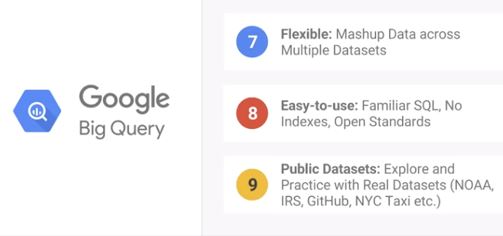
- Three ways to interface with Google Big Query: Web UI, CLI, and REST API.
The Dataprep Pipeline
- Streaming IoT data to Dataprep
- 80% cleaning and preparing data – browser based service

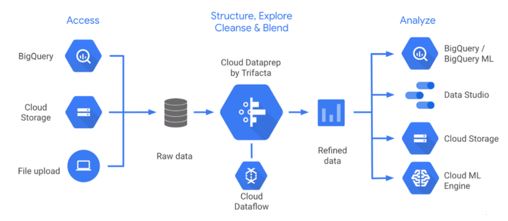
- Dataprep by Trifacta is an intelligent data service for visually exploring, cleaning, and preparing structured and unstructured data for analysis, reporting, and machine learning. Because Dataprep is serverless and works at any scale, there is no infrastructure to deploy or manage. Your next ideal data transformation is suggested and predicted with each UI input, so you don’t have to write code.
The Data Studio Pipeline

- You can give access to the report to another email address.
- Examples: Google Marketing Platform products such as Google Ads, Display & Video 360, and Search Ads 360; Google Consumer products such as Sheets, YouTube, and Search Console.
GCP vs Azure IoT
IoT concepts and Azure IoT Hub:

- Google historically focused on the serverless computing, machine learning and container orchestration via Kubernetes. Google GCP IoT platform stays behind Azure and AWS in terms of the range of services. GCP IoT main use cases are asset tracking and maintenance, logistics and supply chain management, and smart cities/buildings. Google expertise AI and machine learning capabilities like translate, search, and security can bring a competitive advantage over the other two players.
- Azure: Provides a comprehensive set of services that include virtual machines, databases, AI, analytics, IoT, and a strong focus on integration with Microsoft products. GCP: Focuses on data analytics, machine learning, and container orchestration with services like BigQuery, TensorFlow, and Kubernetes
Summary
- IoT is driven by the value of data, not the quality of sensors or improved PaaS
- IoT devices are connected to the cloud directly or through a gateway
- The last few years cloud IoT architectures have made great strides in their ability to ingest, store, process, and analyze very large amounts of real-time data.
- The uses of IoT: predictive maintenance, industry safety solutions, building and home automation, remote patient monitoring, asset tracking, and fraud detection.
- An IoT network must quickly process and store big data in order to gain real-time insights.
Explore More
- A Comparison of Top 14 Supervised ML Techniques for Room Occupancy IoT Monitoring
- EdTech for All: Free/Paid IoT Courses
- Cloud-Native Tech Status Update Q3 2022
- A Comparison of Top 14 Supervised ML Techniques for Room Occupancy IoT Monitoring
References
- Google’s Internet of Things (IoT) solutions make it easy to build connected devices.
- Google Cloud Internet of Things (IoT) Core API: is a complete set of tools to connect, process, store, and analyze data both at the edge and in the cloud
- !pip install google-cloud-iot
- Industrial IoT on Google Cloud
- Industrial IoT on Google Cloud Platform
- Industrial IoT on Google Cloud Platform By Coursera All Quiz & Assignment Answers
- Industrial IOT On Google Cloud Platform|Qwiklabs-Streaming IoT Data to Google Cloud Storage|Coursera
- Level up: Free Coursera courses to build your skills in cloud computing
- IoT Data Pipelines in GCP, multiple ways — Part 1
- IoT Data Pipelines in GCP, multiple ways


One-Time
Monthly
Yearly
Make a one-time donation
Make a monthly donation
Make a yearly donation
Choose an amount
€5.00
€15.00
€100.00
€5.00
€15.00
€100.00
€5.00
€15.00
€100.00
Or enter a custom amount
€
Your contribution is appreciated.
Your contribution is appreciated.
Your contribution is appreciated.
DonateDonate monthlyDonate yearly Our Blogs
Leave a comment