
Photo by Ian Keefe on Unsplash
- The objective of this post is to train and test an optimized multiple-ML model to predict sale price for houses in King County, WA. King county is the most populous county in WA, and the 12th most populous county in the United States.
- Inspired by the earlier studies, we use the GridSearchCV Cross Validation for choosing the best parameters of the following 5 top performing supervised ML regression models: LinearRegression (LR), SGDRegressor (SGD), RandomForestRegressor (RF), XGBRegressor (XGB), and AdaBoostRegressor (Ada).
- The important step in our study is the use of Automated EDA (Exploratory Data Analysis) packages that can perform EDA in a few lines of Python code. Specifically, we will utilize Pandas-Profiling and SweetViz to discover patterns, identify anomalies, and find relationships between variables.
Table of Contents
- Input Dataset
- Automated EDA
- Data Preparation
- House Price Map
- Multiple-ML HPO
- Final Comparison
- Conclusions
- Explore More
Input Dataset
The dataset set used for this analysis is the King County Houses Sales dataset prepared by the county assessor. The dataset contains 21,597 home features and sale price collected during the years 2014–2015. The final model included homes ranging in price from $78,000–$3,100,000.
Following is a description of the model features:
- price — Sale price (prediction target)
- bedrooms — Number of bedrooms
- bathrooms — Number of bathrooms
- sqft_living — Square footage of living space in the home
- sqft_lot — Square footage of the lot
- floors — Number of floors (levels) in house
- waterfront — Whether the house is on a waterfront
- view — Quality of view from house
- condition — How good the overall condition of the house is. Related to maintenance of house.
- grade — Overall grade of the house. Related to the construction and design of the house.
- sqft_above — Square footage of house apart from basement
- sqft_basement — Square footage of the basement
- zipcode — ZIP Code used by the United States Postal Service
Let’s set the working directory HOUSEPRICES
import os
os.chdir(‘HOUSEPRICES’)
os. getcwd()
and import the libraries
import os
import folium
import warnings
import numpy as np
import pandas as pd
import matplotlib.pyplot as plt
import seaborn as sns
from folium.plugins import HeatMap
folds = 5
sns.set(color_codes=True)
from sklearn.metrics import r2_score
from scipy import stats
from sklearn.model_selection import GridSearchCV
score_calc = ‘neg_mean_squared_error’
Let’s read the input data
house_data = pd.read_csv(‘kc_house_data.csv’)
Automated EDA
Let’s import the Pandas-Profiling library to be used for EDA and visualization
from pandas_profiling import ProfileReport
profile = ProfileReport(house_data, title=”Pandas Profiling Report”)
profile.to_file(“reportpandas.html”)
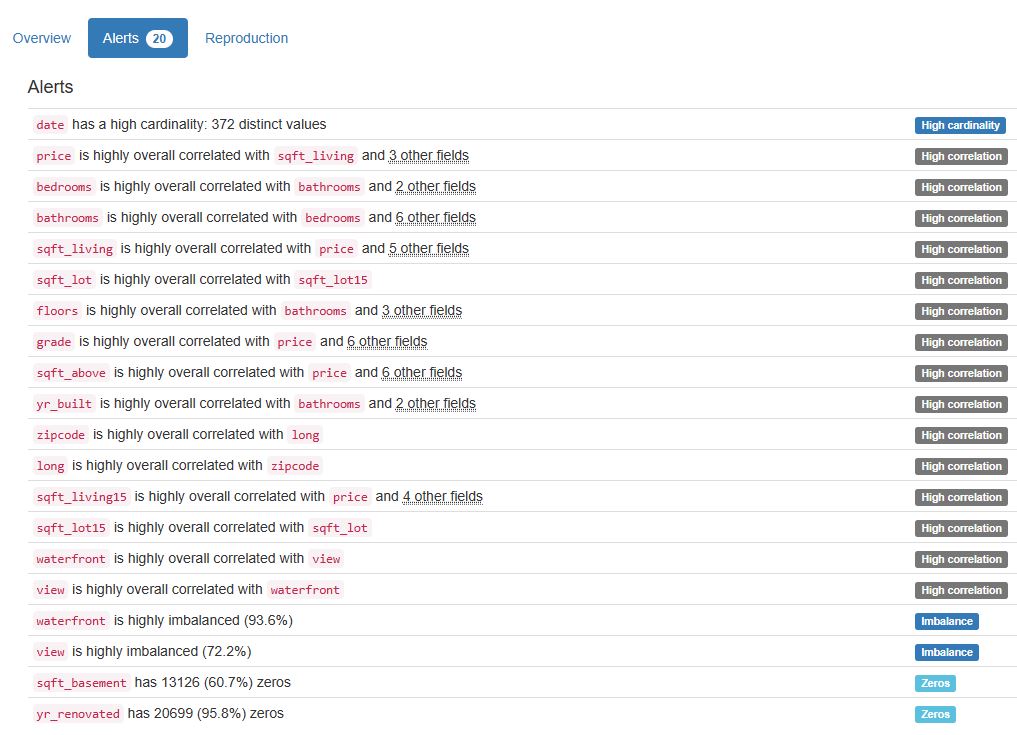
It creates the interactive HTML report reportpandas.html that displays various summary statistics and visualizations of house_data:
Overview

Variables

Interactions

Correlations

Let’s create an analysis report using sweetviz
import sweetviz as sv
eport = sv.analyze(house_data)
Let’s display the report
report.show_html()
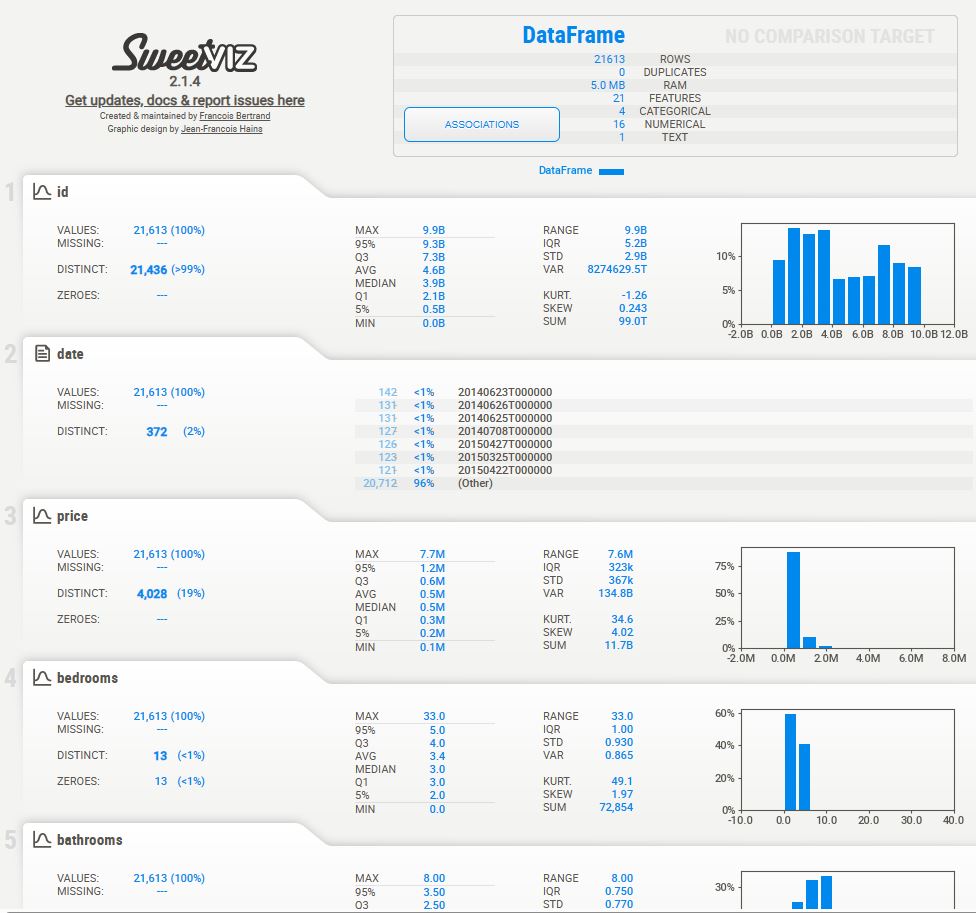
Associations

Squares are categorical associations (uncertainty coefficient & correlation ratio) from 0 to 1. The uncertainty coefficient is assymmetrical, (i.e. ROW LABEL values indicate how much they PROVIDE INFORMATION to each LABEL at the TOP).
• Circles are the symmetrical numerical correlations (Pearson’s) from -1 to 1. The trivial diagonal is intentionally left blank for clarity.
Data Preparation
Let’s drop a few unnecessary columns
house_data_2 = house_data.drop([‘id’, ‘date’],axis=1)
Adding new features
house_data_2[“Home_Age”] = 2023 – house_data_2[“yr_built”]
house_data_2[‘is_renovated’] = house_data_2[“yr_renovated”].where(house_data_2[“yr_renovated”] == 0, 1)
house_data_2[‘Total_Area’] = house_data_2[‘sqft_living’] + house_data_2[‘sqft_lot’] + house_data_2[‘sqft_above’] + house_data_2[‘sqft_basement’]
house_data_2[‘Basement’] = house_data_2[‘sqft_basement’].where(house_data_2[“sqft_basement”] == 0, 1)
and dropping duplicates
house_data_3 = house_data_2.drop_duplicates()
Let’s calculate the ratios
house_data_3[“price_per_sqft_living”] = house_data_3[“price”]/house_data_3[“sqft_living”]
house_data_3[“price_per_total_area”] = house_data_3[“price”]/house_data_3[“Total_Area”]
and apply the following data thresholds
house_data_3[house_data_3[‘price_per_total_area’]>100]
house_data_4 = house_data_3[house_data_3[‘price_per_total_area’] <= 100]
house_data_5 = house_data_4[house_data_4[‘price_per_total_area’] > 5]
house_data_6 = house_data_5[house_data_5[‘price_per_sqft_living’]<=500]
house_data_7 = house_data_6[house_data_6[‘bedrooms’] < 7]
Let’s calculate the following ratios
house_data_7[‘price_per_floor’] = house_data_7[‘price’]/house_data_7[‘floors’]
house_data_7[‘price_per_view’] = house_data_7[‘price’]/house_data_7[‘view’]
Dropping features with poor correlation to price
house_data_8 = house_data_7.drop([‘price_per_view’, ‘sqft_lot15’, ‘long’,
‘waterfront’, ‘condition’, ‘zipcode’,
‘yr_renovated’, ‘is_renovated’, ‘Basement’,
‘Home_Age’, ‘yr_built’, ‘sqft_living15’],axis=1)
house_data_9 = house_data_8.drop([‘bathrooms’, ‘sqft_basement’,
‘lat’, ‘bedrooms’, ‘Total_Area’,
‘floors’, ‘view’], axis=1)
and dropping duplicates
house_data_10 = house_data_9.drop_duplicates()
house_data_10.duplicated().sum()
0
Let’s check the descriptive statistics of the target column ‘price’
house_data_10[‘price’].describe()
count 1.904900e+04
mean 4.969407e+05
std 2.739362e+05
min 8.000000e+04
25% 3.100000e+05
50% 4.310000e+05
75% 6.100000e+05
max 3.300000e+06
Name: price, dtype: float64
House Price Map
Visualizing the house price map
maxpr=house_data_7.loc[house_data_7[‘price’].idxmax()]
def generateBaseMap(default_location=[47.5112, -122.257], default_zoom_start=9.4):
base_map = folium.Map(location=default_location, control_scale=True, zoom_start=default_zoom_start)
return base_map
house_data_7_copy = house_data_7.copy()
house_data_7_copy[‘count’] = 1
basemap = generateBaseMap()
folium.TileLayer(‘cartodbpositron’).add_to(basemap)
s=folium.FeatureGroup(name=’icon’).add_to(basemap)
folium.Marker([maxpr[‘lat’], maxpr[‘long’]],popup=’Highest Price: $’+str(format(maxpr[‘price’],’.0f’)),
icon=folium.Icon(color=’green’)).add_to(s)
HeatMap(data=house_data_7_copy[[‘lat’,’long’,’count’]].groupby([‘lat’,’long’]).sum().reset_index().values.tolist(),
radius=8,max_zoom=13,name=’Heat Map’).add_to(basemap)
folium.LayerControl(collapsed=False).add_to(basemap)
basemap

No surprise that the top home prices are all clustered around downtown Seattle.
Multiple-ML HPO
Let’s train and test several ML model with HPO using the dataset house_data_10
from sklearn.preprocessing import StandardScaler
from sklearn.preprocessing import RobustScaler
from sklearn.preprocessing import MinMaxScaler
from sklearn.model_selection import train_test_split
target = house_data_10[“price”]
features = house_data_10.drop(“price”, axis = 1)
X_train, X_test, Y_train, Y_test = train_test_split(features, target,
test_size = 0.2,
random_state = 1)
sc = StandardScaler()
X_train_sc = pd.DataFrame(sc.fit_transform(X_train))
X_test_sc = pd.DataFrame(sc.transform(X_test))
def get_best_score(grid):
best_score = np.sqrt(-grid.best_score_)
print(best_score)
print(grid.best_params_)
print(grid.best_estimator_)

return best_score
Linear Regression (LR)
from sklearn.linear_model import LinearRegression
LR GridSearchCV
linreg = LinearRegression()
parameters = {‘fit_intercept’:[True,False], ‘positive’:[True,False], ‘copy_X’:[True, False]}
grid_linear = GridSearchCV(linreg, parameters, cv = folds, verbose = 1 , scoring = score_calc)
grid_linear.fit(X_train_sc, Y_train)
sc_linear = get_best_score(grid_linear)
Fitting 5 folds for each of 8 candidates, totalling 40 fits 66518.01517233807 {‘copy_X’: True, ‘fit_intercept’: True, ‘positive’: True} LinearRegression(positive=True)
LR Fit & Predict
LR = LinearRegression()
LR.fit(X_train_sc, Y_train)
pred_linreg_all = LR.predict(X_train_sc)
LR RMSE & R2-Score
from sklearn.metrics import mean_squared_error, r2_score
lr_mse = mean_squared_error(Y_train, pred_linreg_all)
lr_rmse = np.sqrt(lr_mse)
lr_rmse
66418.20377364717
r2_score(Y_train, pred_linreg_all)
0.9411316842046102
SGDRegressor (SGD)
from sklearn.linear_model import SGDRegressor
SGD GridSearchCV
sgd = SGDRegressor()
parameters = {‘max_iter’ :[10000], ‘alpha’:[1e-05], ‘epsilon’:[1e-02], ‘fit_intercept’ : [True] }
grid_sgd = GridSearchCV(sgd, parameters, cv = folds, verbose = 0, scoring = score_calc)
grid_sgd.fit(X_train_sc, Y_train)
sc_sgd = get_best_score(grid_sgd)
pred_sgd = grid_sgd.predict(X_train_sc)
66651.64885381745
{‘alpha’: 1e-05, ‘epsilon’: 0.01, ‘fit_intercept’: True, ‘max_iter’: 10000} SGDRegressor(alpha=1e-05, epsilon=0.01, max_iter=10000)
SGD Train & Predict
sd = SGDRegressor()
sd.fit(X_train_sc, Y_train)
sd_pred = sd.predict(X_train_sc)
SGD Train RMSE & R2-Score
sd_mse = mean_squared_error(Y_train, sd_pred)
sd_rmse = np.sqrt(sd_mse)
sd_rmse
66544.53443852205
r2_score(Y_train, sd_pred)
0.9409075304124359
SGD Test Predict, RMSE & R2-Score
SD_pred = sd.predict(X_test_sc)
SD_mse = mean_squared_error(Y_test, SD_pred)
SD_rmse = np.sqrt(SD_mse)
SD_rmse
68330.26415796539
r2_score(Y_test, SD_pred)
0.9381019885268382
RandomForestRegressor (RF)
from sklearn.ensemble import RandomForestRegressor
RF GridSearchCV
param_grid = {‘min_samples_split’ : [3,4,6,10], ‘n_estimators’ : [70,100], ‘random_state’: [5] }
grid_rf = GridSearchCV(RandomForestRegressor(), param_grid, cv = folds, refit=True, verbose = 0, scoring = score_calc)
grid_rf.fit(X_train, Y_train)
sc_rf = get_best_score(grid_rf)
pred_rf = grid_rf.predict(X_train)
25641.23777655788
{‘min_samples_split’: 3, ‘n_estimators’: 100, ‘random_state’: 5} RandomForestRegressor(min_samples_split=3, random_state=5)
RF Fit & Predict
rf_reg = RandomForestRegressor()
rf_reg.fit(X_train_sc, Y_train)
rf_pred = rf_reg.predict(X_train_sc)
RF Train RMSE & R2-Score
rf_mse = mean_squared_error(Y_train, rf_pred)
rf_rmse = np.sqrt(rf_mse)
rf_rmse
9825.936010452602
r2_score(Y_train, rf_pred)
0.9987115866341476
RF Test RMSE & R2-Score
rfr_pred = rf_reg.predict(X_test_sc)
rfr_mse = mean_squared_error(Y_test, rfr_pred)
rfr_rmse = np.sqrt(rfr_mse)
rfr_rmse
25603.03613090776
r2_score(Y_test, rfr_pred)
0.9913097266751898
XGBRegressor (XGB)
from xgboost import XGBRegressor
XGB GridSearchCV Train Fit, Predict & RMSE
param_grid = {‘learning_rate’ : [0.005,0.01,0.001], ‘n_estimators’ : [40,200], ‘random_state’: [5],
‘max_depth’ : [4,9]}
grid_xgb = GridSearchCV(XGBRegressor(), param_grid, cv = folds, refit=True, verbose = 0, scoring = score_calc)
grid_xgb.fit(X_train, Y_train)
sc_xgb = get_best_score(grid_xgb)
pred_xgb = grid_xgb.predict(X_train)
83083.50687697844
{‘learning_rate’: 0.01, ‘max_depth’: 9, ‘n_estimators’: 200, ‘random_state’: 5} XGBRegressor(base_score=0.5, booster=’gbtree’, callbacks=None, colsample_bylevel=1, colsample_bynode=1, colsample_bytree=1, early_stopping_rounds=None, enable_categorical=False, eval_metric=None, feature_types=None, gamma=0, gpu_id=-1, grow_policy=’depthwise’, importance_type=None, interaction_constraints=”, learning_rate=0.01, max_bin=256, max_cat_threshold=64, max_cat_to_onehot=4, max_delta_step=0, max_depth=9, max_leaves=0, min_child_weight=1, missing=nan, monotone_constraints='()’, n_estimators=200, n_jobs=0, num_parallel_tree=1, predictor=’auto’, random_state=5, …)
Normal XGB Train Fit, Predict & RMSE
xgb = XGBRegressor()
xgb.fit(X_train_sc, Y_train)
xgb_pred = xgb.predict(X_train_sc)
xgb_mse = mean_squared_error(Y_train, xgb_pred)
xgb_rmse = np.sqrt(xgb_mse)
xgb_rmse
8616.954073373103
XGB Test Predict, RMSE & R2-Score: Normal vs GridSearchCV
XGB_pred = xgb.predict(X_test_sc)
XGB_mse = mean_squared_error(Y_test, XGB_pred)
XGB_rmse = np.sqrt(XGB_mse)
XGB_rmse
18472.681261373717
pred_xgb = grid_xgb.predict(X_test)
Xgb_mse = mean_squared_error(Y_test, pred_xgb)
Xgb_rmse = np.sqrt(Xgb_mse)
Xgb_rmse
83969.73243389862
r2_score(Y_test, pred_xgb), r2_score(Y_test, XGB_pred)
(0.9065248788968281, 0.9954761273444909)
AdaBoostRegressor (Ada)
from sklearn.ensemble import AdaBoostRegressor
Ada Train Fit, Predict, RMSE & R2-Score
ada_reg = AdaBoostRegressor(DecisionTreeRegressor(),learning_rate=0.1, random_state=42)
ada_reg.fit(X_train_sc, Y_train)
AdaBoostRegressor(estimator=DecisionTreeRegressor(), learning_rate=0.1, random_state=42)
ada_pred = ada_reg.predict(X_train_sc)
ada_mse = mean_squared_error(Y_train, ada_pred)
ada_rmse = np.sqrt(ada_mse)
ada_rmse
7.561316168386757
r2_score(Y_train, ada_pred)
0.9999999992370393
Ada Test Predict, RMSE & R2-Score
Ada_pred = ada_reg.predict(X_test_sc)
Ada_mse = mean_squared_error(Y_test, Ada_pred)
Ada_rmse = np.sqrt(Ada_mse)
Ada_rmse
18917.817106627022
r2_score(Y_test, Ada_pred)
0.9952554771474822
Final Comparison
Let’s create the ML RMSE test data bar plot that compares RMSE of our 5 best performing algorithms
data = {‘LR’:68236, ‘SGD’:68330, ‘RF’:25603,
‘XGB’:18472,’Ada’:18917}
courses = list(data.keys())
values = list(data.values())
plt.rcParams.update({‘font.size’: 18})
fig = plt.figure(figsize = (10, 5))
plt.bar(courses, values, color =’maroon’,
width = 0.4)
plt.xlabel(“Algorithms”,fontsize=20)
plt.ylabel(“RMSE”,fontsize=20)
plt.title(“ML RMSE Test Data”,fontsize=20)
plt.show()

Conclusions
- We have implemented and tested a multiple-ML HPO regression approach to predict sale prices of homes in the King County, WA.
- We have compared the following 5 top performing supervised ML regression models: LinearRegression (LR), SGDRegressor (SGD), RandomForestRegressor (RF), XGBRegressor (XGB), and AdaBoostRegressor (Ada).
- The best final regression model XGB explained 90.6% of the variance in the test dataset (R2= 0.906). The RMSE of the final model was $18472.7, which is the error in our price prediction for the test dataset.
- The RMSE and R2 metrics showed that the model resolves the high bias-variance trade-off.
- Price for homes with a waterfront are 64.5% higher than homes without a waterfront. No surprise that the top home prices are all clustered around downtown Seattle. These EDA conclusions support previous observations for the same input dataset.
- Results are of interest to WA-based real estate agents who are looking to expand their business into remodeling houses in addition to selling. They can accurately predict the home value based on the statistically significant model features in order to maximize their ROI.
Explore More
- US Real Estate – Harnessing the Power of AI
- Real Estate Supervised ML/AI Linear Regression Revisited – USA House Price Prediction
- A Comparison of Automated EDA Tools in Python: Pandas-Profiling vs SweetViz


Make a one-time donation
Make a monthly donation
Make a yearly donation
Choose an amount
Or enter a custom amount
Your contribution is appreciated.
Your contribution is appreciated.
Your contribution is appreciated.
DonateDonate monthlyDonate yearly Our Blogs
Leave a comment