Tag: ai
-
An Intro to Graph Algorithms in R

This tutorial introduces Graph Algorithms (GA) in R, focusing on Graph Theory and GA-R. It covers graph theory fundamentals, network analysis in R, and the deployment funnel. It also showcases examples of GA-R applications such as the igraph in R demo and the spatial co-location of employees in a workplace network. Industries and companies involved…
-
Titanic Benchmark Hypothesis Testing in Disaster Risk Management: (Auto)EDA, ML, HPO & SHAP

This project aims to apply the Titanic benchmark to hypothesis testing in disaster risk management. Using the Titanic dataset on Kaggle, a Machine Learning (ML) analysis was performed to determine the statistical significance relation between a person’s death and their passenger class, age, sex, and port of embarkation. The project involved comprehensive ML pipeline implementation…
-
Uber’s Orbit Full Bayesian Time Series Forecasting & Inference

This article introduces Orbit, an open-source Python framework by Uber for full Bayesian time series forecasting and inference. It supports models like Exponential Smoothing, Local Global Trend, and Kernel Time-based Regression, along with methods like Markov-Chain Monte Carlo and Variational Inference. Orbit captures uncertainty in time-series data, allowing credible probabilistic forecasts with confidence intervals. The…
-
Kalman-Based Object Tracking with Low Signal/Noise Ratio

This study focuses on real-time object tracking with low signal/noise ratios using Kalman Filter (KF) algorithms. The study covers 1D, 2D, and 3D motion analysis, and explores the impact of noise on the accuracy of object tracking. The accuracy of the KF algorithms in estimating the object’s position and speed in real-time scenarios is evaluated…
-
Malware Detection & Interpretation – PCA, T-SNE & ML

This post discusses the application of PCA, T-SNE, and supervised ML algorithms for malware detection using a benchmark dataset. Techniques such as Logistic Regression, SVC, KNN, and XGBoost are implemented, achieving high performance metrics. Results show potential for improving malware detection using ML while reducing false positives and enhancing cyber defense.
-
Retail Sales, Store Item Demand Time-Series Analysis/Forecasting: AutoEDA, FB Prophet, SARIMAX & Model Tuning

This study compares and evaluates various forecasting models to predict sales and demand for retail businesses. The focus is on Time Series Analysis (TSA) methods such as FB Prophet and SARIMAX. The final FB Prophet model yields MAE=4.252 and MAPE=0.168, while SARIMAX models’ best performing variant achieves MAE=6.285 and MAPE=0.213. The study emphasizes the importance…
-
Sales Forecasting: tslearn, Random Walk, Holt-Winters, SARIMAX, GARCH, Prophet, and LSTM
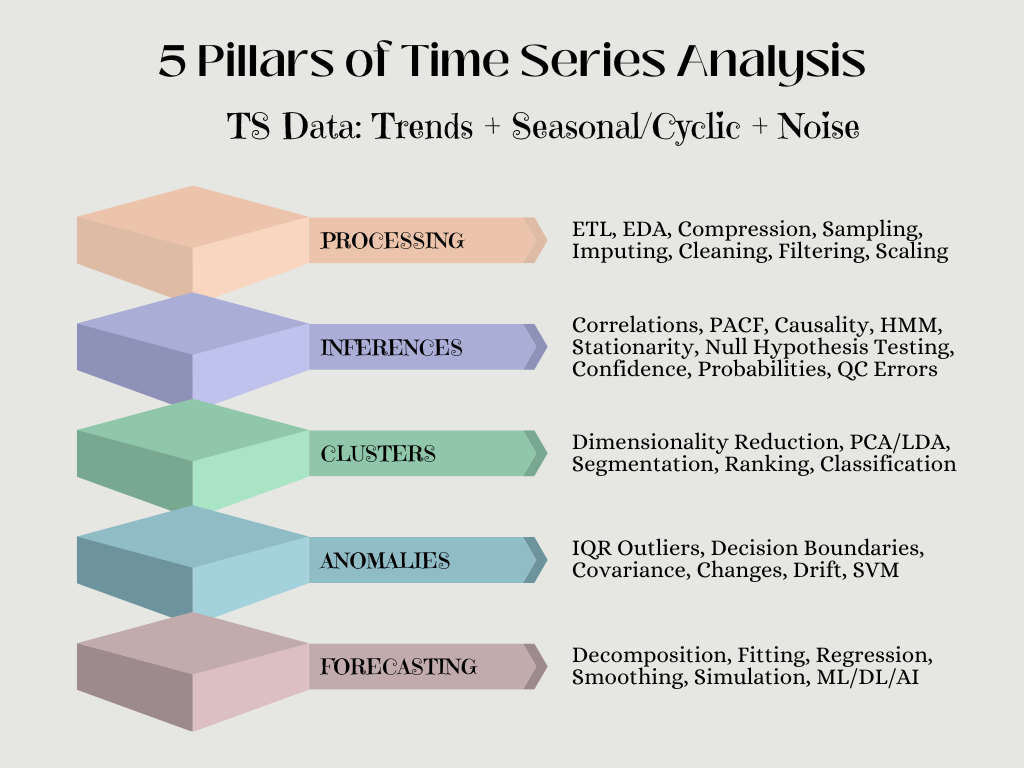
The data science project involves evaluating various sales forecasting algorithms in Python using a Kaggle time-series dataset. The forecasting algorithms include tslearn, Random Walk, Holt-Winters, SARIMA, GARCH, Prophet, LSTM and Di Pietro’s Model. The goal is to predict next month’s sales for a list of shops and products, which slightly changes every month. The best…
-
Working with FRED API in Python: U.S. Recession Forecast & Beyond

The FRED API, or Federal Reserve Economic Data, provides over 267,000 economic time series from 80 sources, offering a wealth of data to promote economic education and research. It encompasses U.S. economic and financial data, including interest rates, monetary indicators, exchange rates, and regional economic data. Additionally, we analyzed correlations, trained currency exchange prediction models,…
-
Top 8 Free AI APIs for Content Design 2023

The post features a variety of AI-powered tools for content creation, including photo restoration, copywriting, and content generation. It showcases various AI systems such as GFPGAN for photo improvement, Copy.ai for copywriting, Notion.ai for generating insights, and Lumen5 for video creation. Lalal.ai is highlighted for audio stem splitting. Additionally, it offers links to explore more…
-
99% Accurate Breast Cancer Classification using Neural Networks in TensorFlow

Breast cancer is a significant global health concern, affecting 12% of women. Machine Learning and Artificial Intelligence techniques play a crucial role in early diagnosis using image features. The study demonstrates a successful Neural Network model for breast cancer classification, achieving 98% accuracy and 98% F1-score. Multiple metrics confirm the model’s efficiency.
-
Heart Failure Prediction using Supervised ML/AI Technique
-
Python Use-Case Supervised ML/AI in Breast Cancer (BC) Classification
https://www.canva.com/design/DAE7oU6O6QQ/share/preview?token=xH-OB2oXeQSrennmqMC2hw&role=EDITOR&utm_content=DAE7oU6O6QQ&utm_campaign=designshare&utm_medium=link&utm_source=sharebutton Acknowledgements with the ML/AI contribution https://hiscidatmlai.blogspot.com/2022/02/digital-transformation-all-way.html… and @VismeApp #Graphics via ref https://visme.co/?ref=al24 Thanks to Mugdha Paithankar [1] and https://kaggle.com/uciml/breast-cancer-wisconsin-data… [2] for the shared open-source content! Introduction Breast Cancer (BC) continues to be the most frequent cancer in females, affecting about one in 8 women and causing the highest number of cancer-related deaths in…
-
About MLOps

Machine Learning (ML), a subset of Artificial Intelligence, enables computers to learn from experience, improving tasks through performance measures. Deployed by businesses across sectors, ML powers various applications such as chatbots, decision support tools, fraud detection, etc. ML uses data analytics concepts like predictive and prescriptive algorithms, and techniques such as supervised, unsupervised, and deep…
 Our Blogs